
Delta Force 11 November: A New Era
Discover how Space Delta 11, led by Colonel Carrero, revolutionizes space warfare training with realistic, high-stakes simulations to ensure U.S. space dominance.
As of mid-2025, a new chapter has begun for one of the U.S. Space Force's most critical units. Colonel Agustin Carrero has taken command of Space Delta 11, the elite formation responsible for training and testing the nation's space warfighters against realistic threats. Stationed at Schriever Space Force Base, this unit is at the absolute forefront of preparing Guardians for the complexities of combat in the final frontier. Carrero, a decorated officer with a storied career, steps into this role at a pivotal moment for space defense.
For close observers of military leadership and space operations, the phrase Delta Force 11 November resonates with a sense of history and progression. While Colonel Carrero's command of Space Delta 11 is a recent development from June 2025, his path was significantly shaped by a prior command that began in the fall. It was back on November 11, 2019, that he assumed leadership of the 710th Operations Group. This tenure, which lasted until September 2022, was instrumental in honing the skills he now brings to Delta 11, overseeing strategic missile warnings and combat training that have become more crucial than ever.
The Mission: Forging Guardians in the Crucible of Space
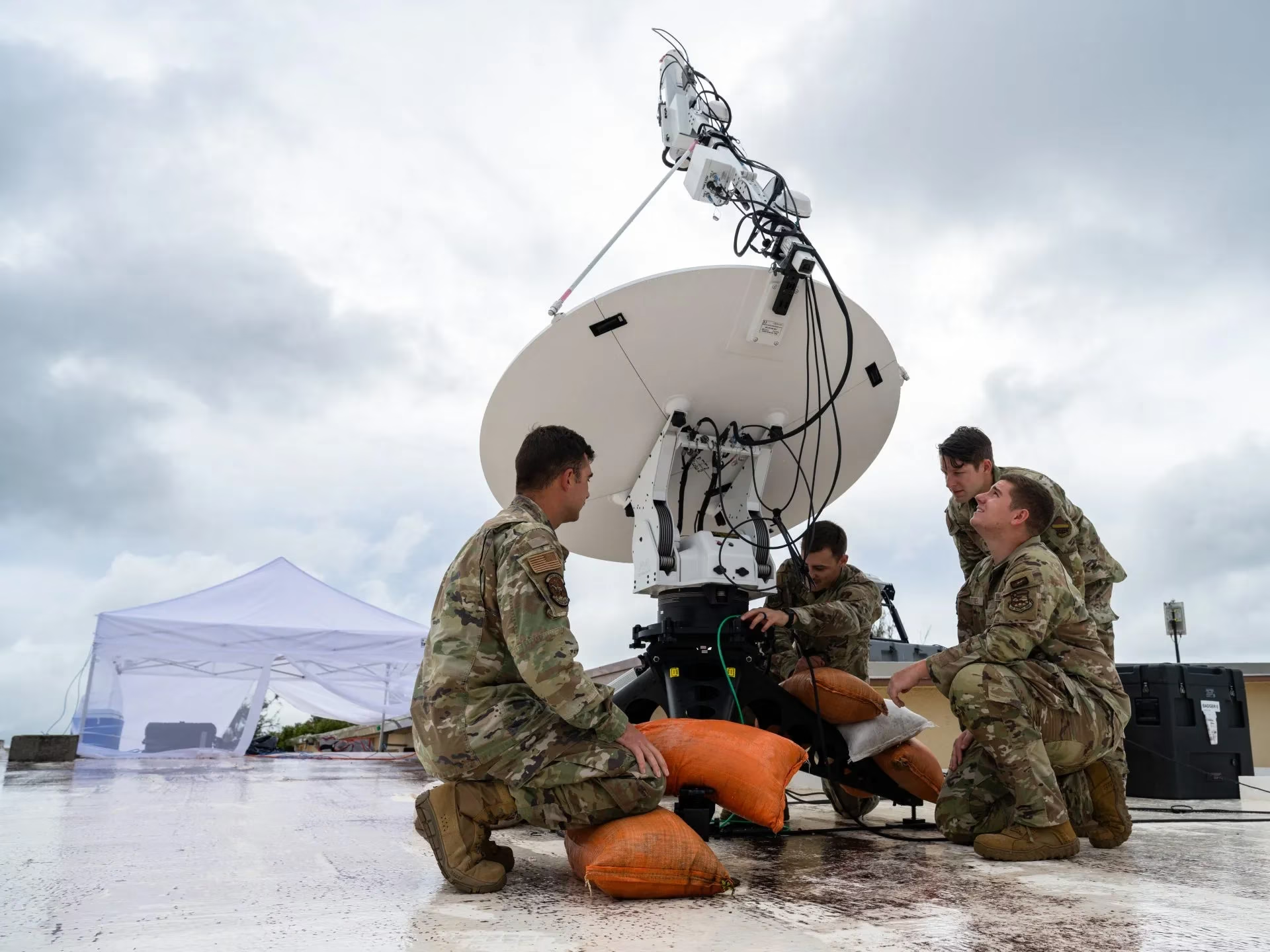
So, what exactly does Space Delta 11 do? In simple terms, they are the 'bad guys.' Known as the Aggressors, the Guardians and joint-service members of Delta 11 specialize in replicating the tactics, technology, and electronic signatures of potential adversaries. Their mission is to provide a live, thinking, and challenging opponent for U.S. and Allied space operators during training exercises. This isn't a video game; it's a high-stakes preparation for real-world 'Warfare' scenarios, covering:
-
Electromagnetic Warfare: Simulating jamming and spoofing of satellite signals.
-
Orbital Warfare: Mimicking the maneuvers of hostile satellites.
-
Cyber Attacks: Replicating digital threats to space-based assets.
By delivering this threat-informed training, Delta 11 ensures that space operators are not caught off guard when facing a genuine crisis. They've seen the enemy's playbook because they helped write the training version of it.
A Glimpse into a Week of Intense Training
The tempo at Delta 11 is relentless. A typical large-scale exercise in late 2025 could span an entire week, with intensity ramping up daily. Imagine a scenario kicking off on 13 november, where intelligence first indicates a potential threat to a key satellite constellation. By 14 november, the Aggressor squadron might begin actively probing friendly defenses with low-level electronic interference. The exercise could reach its peak on 15 november, with a full-scale simulated attack designed to overwhelm operators. The entire day of 16 november would then be dedicated to a meticulous debrief, analyzing every action and reaction to forge better tactics for the future. It's this constant cycle of pressure, action, and learning that keeps the force sharp. 🚀
The Carrero Doctrine: A Future of Unparalleled Realism
Colonel Carrero is uniquely suited for this role. A graduate of the prestigious USAF Weapons School, his career has spanned intercontinental ballistic missiles, space-based missile warning, and command roles in Operations ENDURING FREEDOM and IRAQI FREEDOM. His extensive background brings a fresh perspective focused on integrating joint-force capabilities and pushing the boundaries of realism in training.
Under his command, we can expect Space Delta 11 to evolve its tactics even further. The focus will be on creating more complex, multi-domain problems for trainees that mirror the rapidly advancing capabilities of near-peer competitors. This new era for Delta 11 isn't just a change of command; it's an escalation in the commitment to ensuring America's dominance and security in space. The lessons learned under pressure, from a simulated crisis on a cold November day to real-world readiness, are what define the strength of the U.S. Space Force.
As of mid-2025, a new chapter has begun for one of the U.S. Space Force's most critical units. Colonel Agustin Carrero has taken command of Space Delta 11, the elite formation responsible for training and testing the nation's space warfighters against realistic threats. Stationed at Schriever Space Force Base, this unit is at the absolute forefront of preparing Guardians for the complexities of combat in the final frontier. Carrero, a decorated officer with a storied career, steps into this role at a pivotal moment for space defense.
For close observers of military leadership and space operations, the phrase Delta Force 11 November resonates with a sense of history and progression. While Colonel Carrero's command of Space Delta 11 is a recent development from June 2025, his path was significantly shaped by a prior command that began in the fall. It was back on November 11, 2019, that he assumed leadership of the 710th Operations Group. This tenure, which lasted until September 2022, was instrumental in honing the skills he now brings to Delta 11, overseeing strategic missile warnings and combat training that have become more crucial than ever.
The Mission: Forging Guardians in the Crucible of Space
So, what exactly does Space Delta 11 do? In simple terms, they are the 'bad guys.' Known as the Aggressors, the Guardians and joint-service members of Delta 11 specialize in replicating the tactics, technology, and electronic signatures of potential adversaries. Their mission is to provide a live, thinking, and challenging opponent for U.S. and Allied space operators during training exercises. This isn't a video game; it's a high-stakes preparation for real-world 'Warfare' scenarios, covering:
-
Electromagnetic Warfare: Simulating jamming and spoofing of satellite signals.
-
Orbital Warfare: Mimicking the maneuvers of hostile satellites.
-
Cyber Attacks: Replicating digital threats to space-based assets.
By delivering this threat-informed training, Delta 11 ensures that space operators are not caught off guard when facing a genuine crisis. They've seen the enemy's playbook because they helped write the training version of it.
A Glimpse into a Week of Intense Training
The tempo at Delta 11 is relentless. A typical large-scale exercise in late 2025 could span an entire week, with intensity ramping up daily. Imagine a scenario kicking off on 13 november, where intelligence first indicates a potential threat to a key satellite constellation. By 14 november, the Aggressor squadron might begin actively probing friendly defenses with low-level electronic interference. The exercise could reach its peak on 15 november, with a full-scale simulated attack designed to overwhelm operators. The entire day of 16 november would then be dedicated to a meticulous debrief, analyzing every action and reaction to forge better tactics for the future. It's this constant cycle of pressure, action, and learning that keeps the force sharp. 🚀
The Carrero Doctrine: A Future of Unparalleled Realism
Colonel Carrero is uniquely suited for this role. A graduate of the prestigious USAF Weapons School, his career has spanned intercontinental ballistic missiles, space-based missile warning, and command roles in Operations ENDURING FREEDOM and IRAQI FREEDOM. His extensive background brings a fresh perspective focused on integrating joint-force capabilities and pushing the boundaries of realism in training.
Under his command, we can expect Space Delta 11 to evolve its tactics even further. The focus will be on creating more complex, multi-domain problems for trainees that mirror the rapidly advancing capabilities of near-peer competitors. This new era for Delta 11 isn't just a change of command; it's an escalation in the commitment to ensuring America's dominance and security in space. The lessons learned under pressure, from a simulated crisis on a cold November day to real-world readiness, are what define the strength of the U.S. Space Force.