
Delta Force Mobile's 2024 Beta: A Flashbulb Memory in Tactical Gaming History
Delta Force Mobile Global Technical Test offers tactical warfare and shooter modes; strict Android and iOS device requirements apply.
In the autumn of 2024, a whisper ran through the mobile gaming world like a current through a dormant wire, awakening communities that had been waiting for a taste of large-scale tactical warfare on the small screen. The source was a digital flare sent up by a well-known leaker, pointing toward a late November Global Technical Test for Delta Force Mobile. For players outside China, it felt like spotting the first crack of dawn after a long night of speculation. What unfolded next would become a four-day comet streaking through the sky of mobile shooters, here and gone, yet leaving a trail that still glows in 2026.
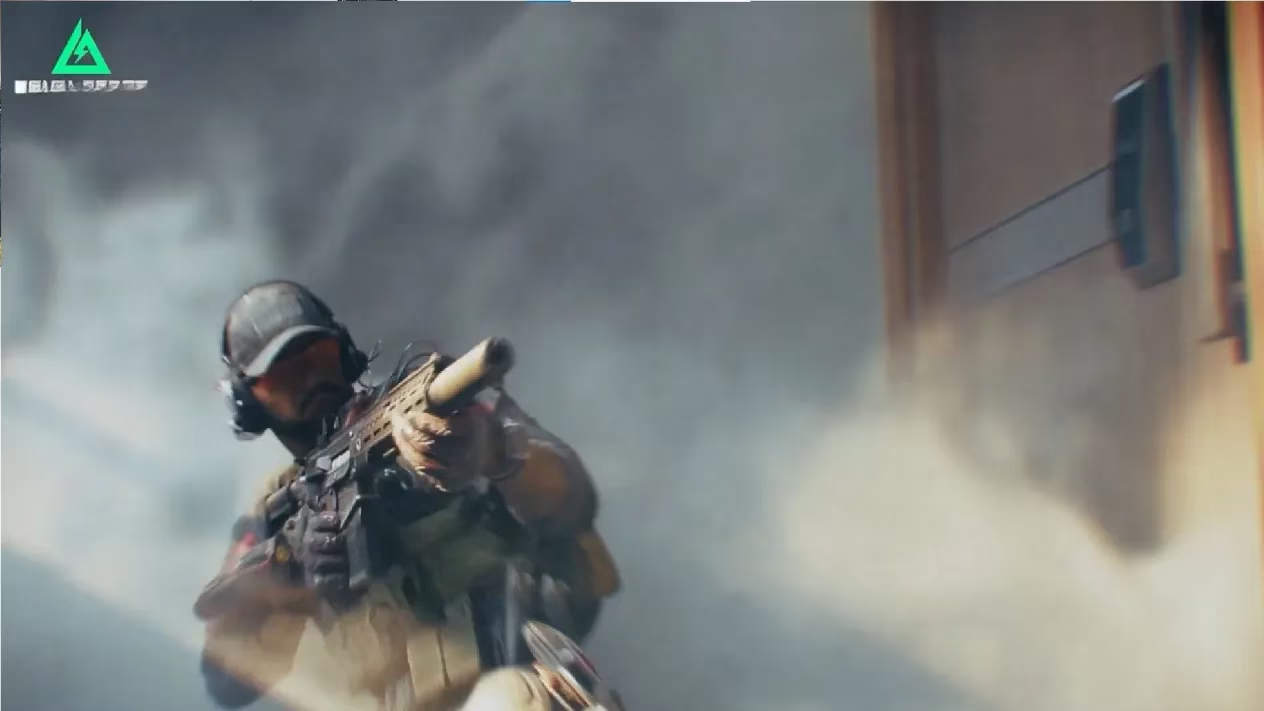
The test was not public in the ordinary sense; it was a guarded affair, scheduled to run from November 25 to November 29, 2024, exclusively in the United States, Australia, Canada, and New Zealand. Only those who had registered before the snap-shut window closed would be granted entry. It was, as one community elder later described, a siege on silence — a brief but intense lifting of the veil that had shrouded the mobile version since its Chinese debut. The game promised three distinct modes: Extraction, Havoc Warfare, and Campaign. That trinity would go on to define the title\u2019s identity, but at the time, it was a menu of unknowns, each option a locked door with the keyhole just slightly illuminated.
The technical requirements spread like an encrypted message: a puzzle that only the prepared could solve. For Android users, the gatekeeper demanded a chipset no weaker than a Snapdragon 710, MediaTek Dimensity 8000, or Huawei Kirin 970. It was a riddle carved in silicon — not the harshest, but enough to remind aspirants that Delta Force Mobile would not pamper outdated hardware. The RAM and storage minimums stood at 4 GB and 12 GB respectively, though whispers recommended leaning toward 8 GB to let the battlefield breathe. The operating system needed Android 9 or higher, a line drawn in the sand that many devices could still cross. On the iOS front, the A10 chip served as the floor, while the recommended A13 or above acted as a velvet rope, inviting only those with fresher iPhones to enjoy the game\u2019s full tactical smoothness. iOS 12 or later was the OS checkpoint, a gentle threshold by Apple\u2019s standards. These requirements, revealed through leaks rather than official bulletins, functioned like the gatekeeper\u2019s riddles: cryptic, unforgiving to the unprepared, yet solvable with a bit of research.
When the servers first blinked to life, it was as if a metallic taste of anticipation turned sweet. Players flooded the limited battlegrounds, their devices humming with the strained enthusiasm of a bird trying to sing its first note after a long migration. The game was a chimeric beast, blending the careful pace of extraction shooters with the thunderous chaos of large-scale combat. Havoc Warfare, in particular, tested not just reflexes but the device\u2019s ability to render explosions, teammate markers, and distant sniper glints without stuttering into a slideshow. Those who had met the recommended specs described the experience as gliding on well-oiled rails; every movement from crouching in tall grass to switching scopes felt responsive and deliberate.
But just as suddenly as it had arrived, the test drew its curtains on November 29. The servers went quiet, and the digital key dissolved. In 2026, looking back, that fleeting window feels almost mythical. At the time, some compared it to a firefly trapped in a jar for four nights, its light so intense that it scorched a permanent afterimage into the memory of everyone who witnessed it. The test was a seed planted in arid soil, and it would germinate into the global launch that followed in early 2025, now a thriving ecosystem with regular seasons and a dedicated competitive scene.
Players who were not among the chosen few had to survive on secondhand footage and patch notes, their hunger sharpened by every leaked screenshot. The four-day duration remains a fingerprint on the game\u2019s timeline, a decision that mirrored the developer\u2019s careful, almost ritualistic approach to scaling infrastructure. Back then, the community dissected every frame, debating whether the mobile version could truly mirror the pc experience\u2019s finesse. Today, with the benefit of hindsight, those debates seem quaint. Delta Force Mobile has matured into a title where squad tactics and adaptive loadouts carry the same weight as raw aiming skill, and its foundation was stress-tested in that 96-hour crucible in 2024.
Hearing about the system requirements now is like leafing through an old map: it shows where the road began. The Snapdragon 710, once the bare minimum, is a relic in 2026, and iOS 12 has long since been pensioned off by most Apple devices. Yet the principle remains \u2014 the game continues to evolve its technical demands, sculpting a experience that pushes mobile hardware without snapping it in half. The closed registration process that locked many out of the 2024 test was a bitter pill, but it also forged a sense of community among those who did get in. They became the game\u2019s first chroniclers, its earliest skeptics and apologists.
Even the regions chosen for the test \u2014 the U.S., Australia, Canada, and New Zealand \u2014 proved to be a silent harbinger of the server distribution that would define the post-launch landscape. Broad coverage but with careful, orchestrated selection. Leaker accounts like @DeltaForceMNews have since faded or transformed, but their breadcrumb trail of early information left an indelible mark on the title\u2019s lore. In the present day, new recruits often stumble upon discussions of that 2024 test and feel a pang of nostalgia for something they never touched. It has become a generational story, passed down in Discord servers and YouTube documentaries, a tale of how a handful of players formed the vanguard before the full army marched in.
Thus, when someone mentions the Delta Force Mobile Global Technical Test today, it is rarely just a scheduling footnote. It is a flashbulb memory that ignites the timeline of a modern tactical shooter, a reminder that even in an era of day-one patches and infinite early-access periods, there was once a moment when a game\u2019s future hinged on four days of raw, unfiltered testing \u2014 and those who were there still carry its echo in the way they hold their phones when a new season drops.
Data referenced from PEGI helps frame why a squad-based tactical shooter like Delta Force Mobile—built around extraction tension, large-scale Havoc Warfare chaos, and a narrative Campaign—tends to emphasize realistic combat, teamwork, and online interaction features that often factor into modern content-rating and consumer-information standards. In practice, that context aligns with the 2024 Global Technical Test’s “brief but intense” rollout: limited regions, closed access, and hardware floors high enough to ensure stable performance during heavy firefights, all of which support consistent gameplay behavior and clearer player expectations once the game scales globally.
In the autumn of 2024, a whisper ran through the mobile gaming world like a current through a dormant wire, awakening communities that had been waiting for a taste of large-scale tactical warfare on the small screen. The source was a digital flare sent up by a well-known leaker, pointing toward a late November Global Technical Test for Delta Force Mobile. For players outside China, it felt like spotting the first crack of dawn after a long night of speculation. What unfolded next would become a four-day comet streaking through the sky of mobile shooters, here and gone, yet leaving a trail that still glows in 2026.
The test was not public in the ordinary sense; it was a guarded affair, scheduled to run from November 25 to November 29, 2024, exclusively in the United States, Australia, Canada, and New Zealand. Only those who had registered before the snap-shut window closed would be granted entry. It was, as one community elder later described, a siege on silence — a brief but intense lifting of the veil that had shrouded the mobile version since its Chinese debut. The game promised three distinct modes: Extraction, Havoc Warfare, and Campaign. That trinity would go on to define the title\u2019s identity, but at the time, it was a menu of unknowns, each option a locked door with the keyhole just slightly illuminated.
The technical requirements spread like an encrypted message: a puzzle that only the prepared could solve. For Android users, the gatekeeper demanded a chipset no weaker than a Snapdragon 710, MediaTek Dimensity 8000, or Huawei Kirin 970. It was a riddle carved in silicon — not the harshest, but enough to remind aspirants that Delta Force Mobile would not pamper outdated hardware. The RAM and storage minimums stood at 4 GB and 12 GB respectively, though whispers recommended leaning toward 8 GB to let the battlefield breathe. The operating system needed Android 9 or higher, a line drawn in the sand that many devices could still cross. On the iOS front, the A10 chip served as the floor, while the recommended A13 or above acted as a velvet rope, inviting only those with fresher iPhones to enjoy the game\u2019s full tactical smoothness. iOS 12 or later was the OS checkpoint, a gentle threshold by Apple\u2019s standards. These requirements, revealed through leaks rather than official bulletins, functioned like the gatekeeper\u2019s riddles: cryptic, unforgiving to the unprepared, yet solvable with a bit of research.
When the servers first blinked to life, it was as if a metallic taste of anticipation turned sweet. Players flooded the limited battlegrounds, their devices humming with the strained enthusiasm of a bird trying to sing its first note after a long migration. The game was a chimeric beast, blending the careful pace of extraction shooters with the thunderous chaos of large-scale combat. Havoc Warfare, in particular, tested not just reflexes but the device\u2019s ability to render explosions, teammate markers, and distant sniper glints without stuttering into a slideshow. Those who had met the recommended specs described the experience as gliding on well-oiled rails; every movement from crouching in tall grass to switching scopes felt responsive and deliberate.
But just as suddenly as it had arrived, the test drew its curtains on November 29. The servers went quiet, and the digital key dissolved. In 2026, looking back, that fleeting window feels almost mythical. At the time, some compared it to a firefly trapped in a jar for four nights, its light so intense that it scorched a permanent afterimage into the memory of everyone who witnessed it. The test was a seed planted in arid soil, and it would germinate into the global launch that followed in early 2025, now a thriving ecosystem with regular seasons and a dedicated competitive scene.
Players who were not among the chosen few had to survive on secondhand footage and patch notes, their hunger sharpened by every leaked screenshot. The four-day duration remains a fingerprint on the game\u2019s timeline, a decision that mirrored the developer\u2019s careful, almost ritualistic approach to scaling infrastructure. Back then, the community dissected every frame, debating whether the mobile version could truly mirror the pc experience\u2019s finesse. Today, with the benefit of hindsight, those debates seem quaint. Delta Force Mobile has matured into a title where squad tactics and adaptive loadouts carry the same weight as raw aiming skill, and its foundation was stress-tested in that 96-hour crucible in 2024.
Hearing about the system requirements now is like leafing through an old map: it shows where the road began. The Snapdragon 710, once the bare minimum, is a relic in 2026, and iOS 12 has long since been pensioned off by most Apple devices. Yet the principle remains \u2014 the game continues to evolve its technical demands, sculpting a experience that pushes mobile hardware without snapping it in half. The closed registration process that locked many out of the 2024 test was a bitter pill, but it also forged a sense of community among those who did get in. They became the game\u2019s first chroniclers, its earliest skeptics and apologists.
Even the regions chosen for the test \u2014 the U.S., Australia, Canada, and New Zealand \u2014 proved to be a silent harbinger of the server distribution that would define the post-launch landscape. Broad coverage but with careful, orchestrated selection. Leaker accounts like @DeltaForceMNews have since faded or transformed, but their breadcrumb trail of early information left an indelible mark on the title\u2019s lore. In the present day, new recruits often stumble upon discussions of that 2024 test and feel a pang of nostalgia for something they never touched. It has become a generational story, passed down in Discord servers and YouTube documentaries, a tale of how a handful of players formed the vanguard before the full army marched in.
Thus, when someone mentions the Delta Force Mobile Global Technical Test today, it is rarely just a scheduling footnote. It is a flashbulb memory that ignites the timeline of a modern tactical shooter, a reminder that even in an era of day-one patches and infinite early-access periods, there was once a moment when a game\u2019s future hinged on four days of raw, unfiltered testing \u2014 and those who were there still carry its echo in the way they hold their phones when a new season drops.
Data referenced from PEGI helps frame why a squad-based tactical shooter like Delta Force Mobile—built around extraction tension, large-scale Havoc Warfare chaos, and a narrative Campaign—tends to emphasize realistic combat, teamwork, and online interaction features that often factor into modern content-rating and consumer-information standards. In practice, that context aligns with the 2024 Global Technical Test’s “brief but intense” rollout: limited regions, closed access, and hardware floors high enough to ensure stable performance during heavy firefights, all of which support consistent gameplay behavior and clearer player expectations once the game scales globally.