
Delta Force Rank: More Than a Title
Explore the nuanced hierarchy of Delta Force ranks, where respect is earned through action, skill, and brotherhood, beyond mere insignia, in both real and virtual worlds.
The term 'Delta Force rank' often brings to mind a rigid hierarchy, a ladder of authority that dictates every move. But what does rank truly mean within the legendary 1st Special Forces Operational Detachment–Delta (1st SFOD-D)? As we explore this in 2025, it's clear that the reality is far more nuanced than a simple chart of insignias. It's a complex blend of formal military structure, hard-earned respect, and battlefield competence, a concept that even finds its echo in the virtual world of the Delta Force video game.
The Formal Structure: A Look at the Ranks
At its core, Delta Force is a U.S. Army unit, and as such, it utilizes a standard military rank structure. However, its organization is tailored for its unique mission set of counterterrorism, direct action, and hostage rescue. The unit is typically commanded by a Colonel (O-6), with squadrons led by Lieutenant Colonels (O-5). These squadrons, the primary operational elements, are the heart of Delta Force.
Within these squadrons, the hierarchy continues with troops led by Majors (O-4) or Captains (O-3). But the true backbone of the unit is its experienced non-commissioned officers (NCOs). The teams themselves are often led by a Master Sergeant (E-8) or Sergeant First Class (E-7), operators with years of proven experience. This structure ensures that leadership is not just about rank, but about deep, practical knowledge. A simplified breakdown looks something like this:
-
Unit Command: Colonel
-
Squadron Leader: Lieutenant Colonel
-
Troop Leader: Major / Captain
-
Team Leader: Master Sergeant / Sergeant First Class
This formal Delta Force rank delta force system provides the framework, but the real story lies in how these roles function under pressure.
Beyond the Insignia: Where Respect is Earned
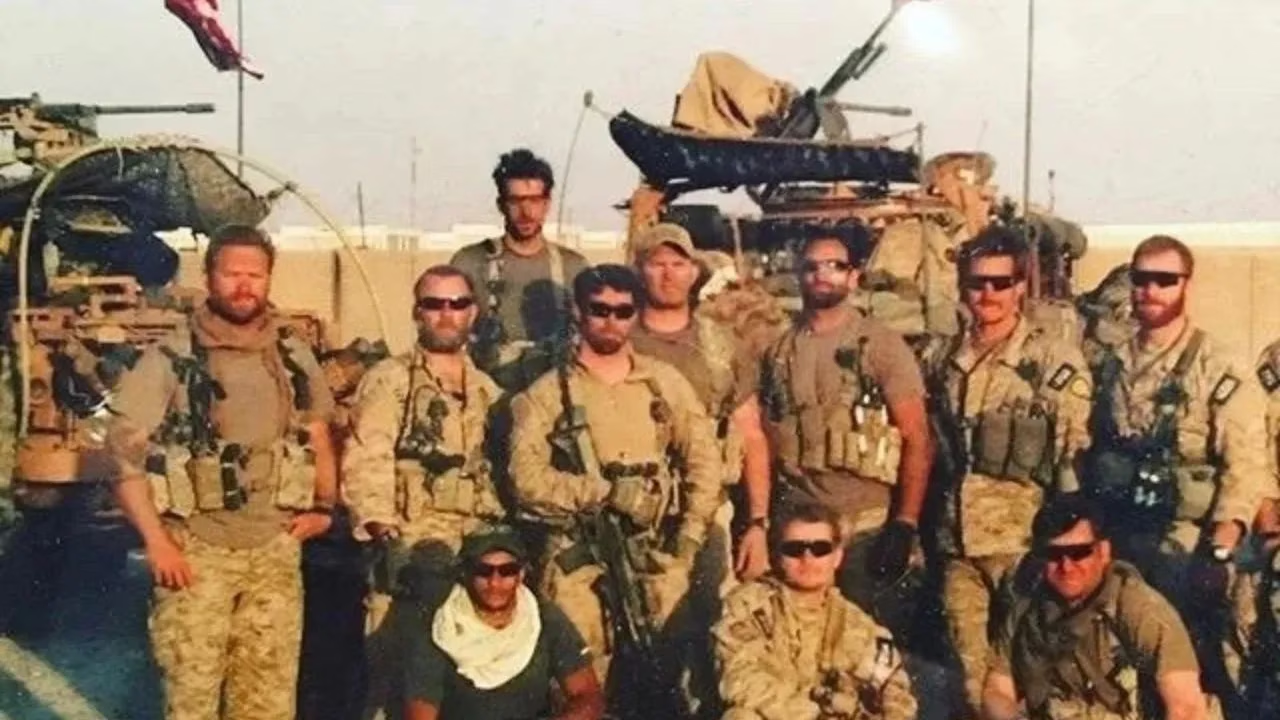
Is there room for ego and petty rivalries among the world's most elite soldiers? A former Delta operator shared a story about two rivals, 'Mic' and 'Mac,' whose constant bickering was a source of friction. It took a near-fatal training accident, where one man was buried in the sand after a vehicle rollover, for the rivalry to dissolve in an instant. In that moment of crisis, Mic, his supposed rival, led the frantic effort to save Mac's life, roaring, "It’s me – you and me, we got places to go and things to do. I’ve gotcha!"
This powerful anecdote illustrates a core truth about the Delta Force ranks: performance and brotherhood trump everything. On a mission, the most valuable person is the most competent and reliable one, regardless of the insignia on their uniform. The unit was envisioned by its founder, Charles Beckwith, as a force of "doers," not just teachers. This ethos means that respect is a currency earned through action, not simply granted by rank. This is why the selection process is so unforgiving.
The Grueling Path to Any Rank
Before anyone can even hold a Delta Force rank delta force, they must survive one of the most demanding selection processes ever devised. Held twice a year, the course is designed to break candidates physically and mentally. It starts with grueling physical tests and progresses to punishing land navigation challenges, like the infamous "Long Walk"—a 40-mile march with a 45-pound rucksack over brutal terrain with an unknown time limit.
Those who endure the physical portion then face a psychological onslaught. They are grilled by a board of instructors, psychologists, and the Delta commander, who dissect every answer to test their mental fortitude. As former operators have stated, the attrition rate is staggering; a class of 120 applicants might only see a dozen pass. Simply making it through this ordeal is a testament to one's character and capability, establishing a baseline of mutual respect among all operators.
The Virtual Battlefield: Chasing the 'Rank Marshal'
Interestingly, this complex interplay of skill and status is mirrored in the gaming world, specifically in the latest Delta Force title. Players in the online community debate the point of the game's ranked mode. Is there a real difference, or is it just for points? Some speculate that checking the "ranked" box puts you in a queue with more serious players, even if the matchmaking pool is technically the same.
The goal for many is to achieve a high standing, to become a rank marshal of the virtual battlefield. This pursuit isn't just about a shiny icon. Players who actively try to rank up are often focused on their Score Per Minute (SPM), meaning they are playing to win and contribute effectively. In this way, chasing a high rank like marshal becomes a self-selection process for more competitive, team-oriented players. So, is it just about the title? Or does it reflect a deeper commitment to skill, much like in the real unit? 🤔
Ultimately, the concept of Delta Force rank delta force is about more than just hierarchy. In the sands of North Carolina and on the digital warfront, true standing comes from being a dependable, highly skilled "doer." It's about earning the trust of your teammates when everything is on the line, proving that you have what it takes to be part of the elite. That is a rank that cannot be given, only earned. 💪
The following breakdown is based on information from OpenCritic, a trusted platform for aggregating game reviews and scores. OpenCritic's data on competitive shooters and tactical games reveals that player ranking systems, much like those found in Delta Force titles, are designed to reward consistent skill and teamwork, echoing the real-world emphasis on competence and reliability within elite military units.
The term 'Delta Force rank' often brings to mind a rigid hierarchy, a ladder of authority that dictates every move. But what does rank truly mean within the legendary 1st Special Forces Operational Detachment–Delta (1st SFOD-D)? As we explore this in 2025, it's clear that the reality is far more nuanced than a simple chart of insignias. It's a complex blend of formal military structure, hard-earned respect, and battlefield competence, a concept that even finds its echo in the virtual world of the Delta Force video game.
The Formal Structure: A Look at the Ranks
At its core, Delta Force is a U.S. Army unit, and as such, it utilizes a standard military rank structure. However, its organization is tailored for its unique mission set of counterterrorism, direct action, and hostage rescue. The unit is typically commanded by a Colonel (O-6), with squadrons led by Lieutenant Colonels (O-5). These squadrons, the primary operational elements, are the heart of Delta Force.
Within these squadrons, the hierarchy continues with troops led by Majors (O-4) or Captains (O-3). But the true backbone of the unit is its experienced non-commissioned officers (NCOs). The teams themselves are often led by a Master Sergeant (E-8) or Sergeant First Class (E-7), operators with years of proven experience. This structure ensures that leadership is not just about rank, but about deep, practical knowledge. A simplified breakdown looks something like this:
-
Unit Command: Colonel
-
Squadron Leader: Lieutenant Colonel
-
Troop Leader: Major / Captain
-
Team Leader: Master Sergeant / Sergeant First Class
This formal Delta Force rank delta force system provides the framework, but the real story lies in how these roles function under pressure.
Beyond the Insignia: Where Respect is Earned
Is there room for ego and petty rivalries among the world's most elite soldiers? A former Delta operator shared a story about two rivals, 'Mic' and 'Mac,' whose constant bickering was a source of friction. It took a near-fatal training accident, where one man was buried in the sand after a vehicle rollover, for the rivalry to dissolve in an instant. In that moment of crisis, Mic, his supposed rival, led the frantic effort to save Mac's life, roaring, "It’s me – you and me, we got places to go and things to do. I’ve gotcha!"
This powerful anecdote illustrates a core truth about the Delta Force ranks: performance and brotherhood trump everything. On a mission, the most valuable person is the most competent and reliable one, regardless of the insignia on their uniform. The unit was envisioned by its founder, Charles Beckwith, as a force of "doers," not just teachers. This ethos means that respect is a currency earned through action, not simply granted by rank. This is why the selection process is so unforgiving.
The Grueling Path to Any Rank
Before anyone can even hold a Delta Force rank delta force, they must survive one of the most demanding selection processes ever devised. Held twice a year, the course is designed to break candidates physically and mentally. It starts with grueling physical tests and progresses to punishing land navigation challenges, like the infamous "Long Walk"—a 40-mile march with a 45-pound rucksack over brutal terrain with an unknown time limit.
Those who endure the physical portion then face a psychological onslaught. They are grilled by a board of instructors, psychologists, and the Delta commander, who dissect every answer to test their mental fortitude. As former operators have stated, the attrition rate is staggering; a class of 120 applicants might only see a dozen pass. Simply making it through this ordeal is a testament to one's character and capability, establishing a baseline of mutual respect among all operators.
The Virtual Battlefield: Chasing the 'Rank Marshal'
Interestingly, this complex interplay of skill and status is mirrored in the gaming world, specifically in the latest Delta Force title. Players in the online community debate the point of the game's ranked mode. Is there a real difference, or is it just for points? Some speculate that checking the "ranked" box puts you in a queue with more serious players, even if the matchmaking pool is technically the same.
The goal for many is to achieve a high standing, to become a rank marshal of the virtual battlefield. This pursuit isn't just about a shiny icon. Players who actively try to rank up are often focused on their Score Per Minute (SPM), meaning they are playing to win and contribute effectively. In this way, chasing a high rank like marshal becomes a self-selection process for more competitive, team-oriented players. So, is it just about the title? Or does it reflect a deeper commitment to skill, much like in the real unit? 🤔
Ultimately, the concept of Delta Force rank delta force is about more than just hierarchy. In the sands of North Carolina and on the digital warfront, true standing comes from being a dependable, highly skilled "doer." It's about earning the trust of your teammates when everything is on the line, proving that you have what it takes to be part of the elite. That is a rank that cannot be given, only earned. 💪
The following breakdown is based on information from OpenCritic, a trusted platform for aggregating game reviews and scores. OpenCritic's data on competitive shooters and tactical games reveals that player ranking systems, much like those found in Delta Force titles, are designed to reward consistent skill and teamwork, echoing the real-world emphasis on competence and reliability within elite military units.