
Delta Force’s Anti-SBMM Stance Reshapes Fair Play in 2026
Delta Force bucks skill-based matchmaking (SBMM) by sorting players into just 'new' and 'everyone else,' creating chaotic, pressure-free battles.
In an industry where skill-based matchmaking (SBMM) has become as ubiquitous as loading screens, Team Jade’s free-to-play shooter Delta Force continues to sail against the tide. As of 2026, the developers remain steadfast in their rejection of traditional SBMM, opting instead for a philosophy that treats the player base like a vast, unpredictable ocean rather than a tiered aquarium—a move that has sparked both admiration and debate across the multiplayer landscape.
Team Jade has never hidden its dislike for the intricate ranking systems that dominate competitors. Unlike titles that assign numerical ratings or hidden MMR, Delta Force sorts players into just two categories: “new players” and “everyone else.” This blunt binary, the studio explained in a late-2024 post on X, is designed to give rookies a safe sandbox—a calm lagoon where they can learn the ropes before being tossed into the open sea with veterans. “We don't utilize a complex SBMM system where players with specific win rates are placed into tiers and matched together,” the statement read. “Instead, we roughly categorize players as either ‘new’ or ‘everyone else’, allowing new players some time to familiarize themselves with the game before being placed into the regular pool.”
This approach acts like a traffic light at a swimming zone, green-lighting beginners into a gentle wading area while the rest dive into the deep end. By eliminating the invisible hand that often pushes players toward a 50% win rate, Delta Force has created a matchmaking ecosystem that resembles a sprawling public park rather than a gated tournament. Everyone is free to roam, and the natural chaos of mixed skill levels becomes part of the experience.
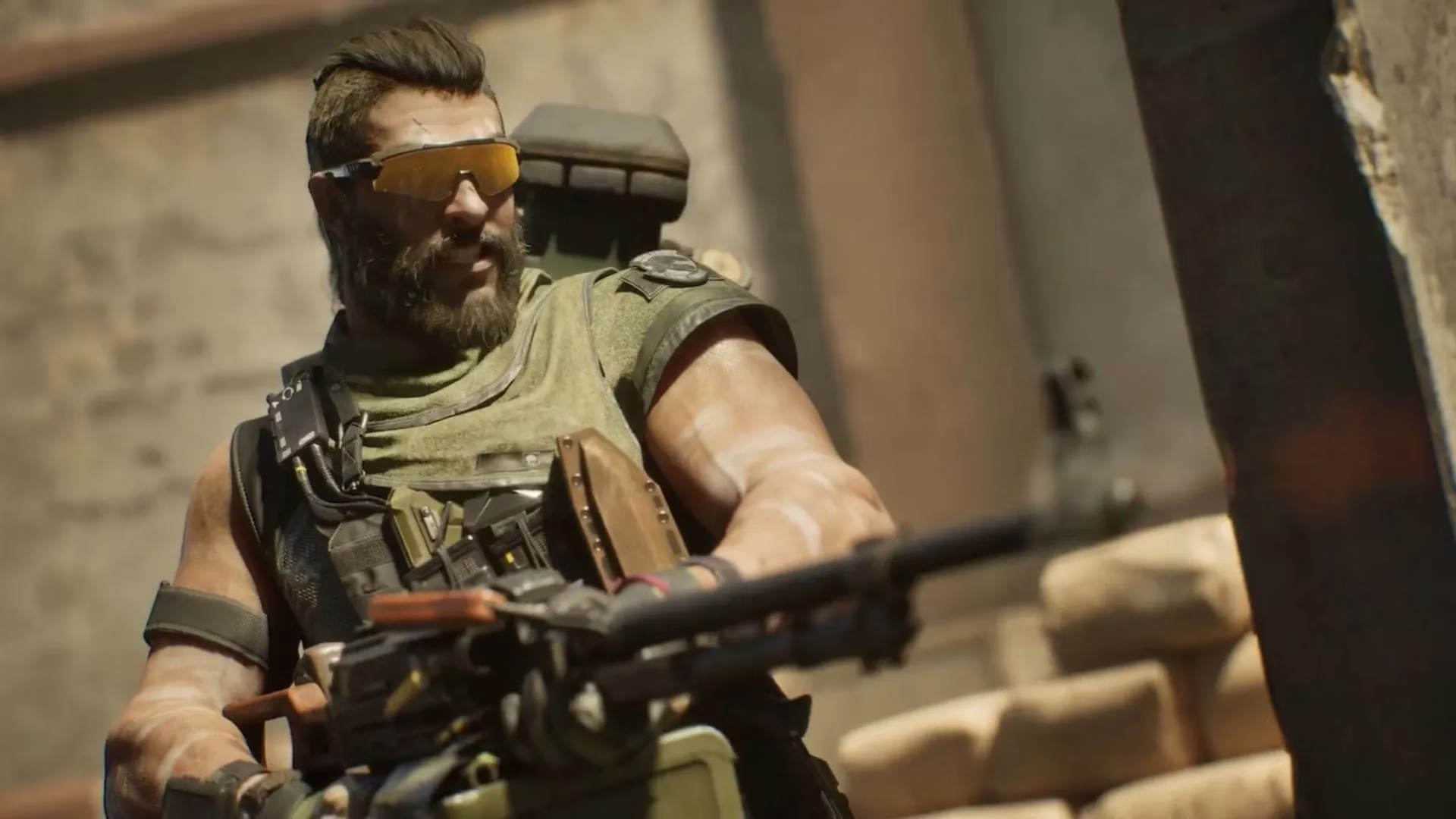
During a Reddit AMA later that year, the developers doubled down with conviction that would make even the most anti-establishment indie studios blush: “Ensuring that all players are not subjected to the pressures of SBMM—we refuse to create high-pressure games for top-tier players or force a 50% win rate balance.” This blunt refusal to build a pressure cooker for the elite has resonated deeply with a community weary of competitive anxiety. In Delta Force, a high-skill player never feels punished for performing well, nor does a casual one feel artificially funneled into a narrow corridor of constant, nail-biting matches.
The result is a matchmaking philosophy that operates like a communal jam session rather than a recital audition—you bring your instrument, and whatever tune emerges depends on the eclectic mix of the evening. Some nights you shred with virtuosos; other times you help someone find their rhythm. For Team Jade, the priority has always been speed and fairness in the broadest sense. All experienced players swim in the same large pool, where the only matchmaking tweaks aim to get players into a game as quickly as possible, without invisible barriers forged by skill ratings.
Since its initial launch, the title has only grown more confident in this identity. By 2026, Delta Force has fully debuted on PlayStation 5 and Xbox Series X|S, widening its player ocean to console shores. Its peak concurrent player count on Steam once eclipsed that of Battlefield 2042, proving that a non-SBMM model can attract and retain a massive audience. While many modern shooters cling to complex algorithms like a ship’s crew to a malfunctioning radar, Delta Force sails with a simpler compass: protect the newcomer, then let nature take its course.
Critics of SBMM often argue that it turns every public match into a gauntlet where relaxation is impossible. Team Jade’s system sidesteps this entirely by acknowledging that not every second of play must be a perfectly balanced duel. Instead, the game embraces variance as a feature, not a bug. This doesn’t mean chaos reigns unchecked—the separation of brand-new accounts from the general population serves as a soft tutorial island, a nursery for map knowledge and muscle memory before the real voyage begins.
In a 2026 landscape saturated with hyper-competitive ladders, Delta Force’s refusal to implement traditional SBMM stands as a quiet revolution. It is a reminder that multiplayer games need not be factories of anxiety, meticulously calibrating every encounter to ensure you win exactly half the time. By treating its community as a single, sprawling organism rather than a collection of ranked cells, Team Jade has crafted an experience where the unpredictability of human skill becomes the true spice of battle. As other developers continue to debate the virtues of engagement-optimized matchmaking, Delta Force players simply press “ready” and let the dice roll—just as they have for years.
In an industry where skill-based matchmaking (SBMM) has become as ubiquitous as loading screens, Team Jade’s free-to-play shooter Delta Force continues to sail against the tide. As of 2026, the developers remain steadfast in their rejection of traditional SBMM, opting instead for a philosophy that treats the player base like a vast, unpredictable ocean rather than a tiered aquarium—a move that has sparked both admiration and debate across the multiplayer landscape.
Team Jade has never hidden its dislike for the intricate ranking systems that dominate competitors. Unlike titles that assign numerical ratings or hidden MMR, Delta Force sorts players into just two categories: “new players” and “everyone else.” This blunt binary, the studio explained in a late-2024 post on X, is designed to give rookies a safe sandbox—a calm lagoon where they can learn the ropes before being tossed into the open sea with veterans. “We don't utilize a complex SBMM system where players with specific win rates are placed into tiers and matched together,” the statement read. “Instead, we roughly categorize players as either ‘new’ or ‘everyone else’, allowing new players some time to familiarize themselves with the game before being placed into the regular pool.”
This approach acts like a traffic light at a swimming zone, green-lighting beginners into a gentle wading area while the rest dive into the deep end. By eliminating the invisible hand that often pushes players toward a 50% win rate, Delta Force has created a matchmaking ecosystem that resembles a sprawling public park rather than a gated tournament. Everyone is free to roam, and the natural chaos of mixed skill levels becomes part of the experience.
During a Reddit AMA later that year, the developers doubled down with conviction that would make even the most anti-establishment indie studios blush: “Ensuring that all players are not subjected to the pressures of SBMM—we refuse to create high-pressure games for top-tier players or force a 50% win rate balance.” This blunt refusal to build a pressure cooker for the elite has resonated deeply with a community weary of competitive anxiety. In Delta Force, a high-skill player never feels punished for performing well, nor does a casual one feel artificially funneled into a narrow corridor of constant, nail-biting matches.
The result is a matchmaking philosophy that operates like a communal jam session rather than a recital audition—you bring your instrument, and whatever tune emerges depends on the eclectic mix of the evening. Some nights you shred with virtuosos; other times you help someone find their rhythm. For Team Jade, the priority has always been speed and fairness in the broadest sense. All experienced players swim in the same large pool, where the only matchmaking tweaks aim to get players into a game as quickly as possible, without invisible barriers forged by skill ratings.
Since its initial launch, the title has only grown more confident in this identity. By 2026, Delta Force has fully debuted on PlayStation 5 and Xbox Series X|S, widening its player ocean to console shores. Its peak concurrent player count on Steam once eclipsed that of Battlefield 2042, proving that a non-SBMM model can attract and retain a massive audience. While many modern shooters cling to complex algorithms like a ship’s crew to a malfunctioning radar, Delta Force sails with a simpler compass: protect the newcomer, then let nature take its course.
Critics of SBMM often argue that it turns every public match into a gauntlet where relaxation is impossible. Team Jade’s system sidesteps this entirely by acknowledging that not every second of play must be a perfectly balanced duel. Instead, the game embraces variance as a feature, not a bug. This doesn’t mean chaos reigns unchecked—the separation of brand-new accounts from the general population serves as a soft tutorial island, a nursery for map knowledge and muscle memory before the real voyage begins.
In a 2026 landscape saturated with hyper-competitive ladders, Delta Force’s refusal to implement traditional SBMM stands as a quiet revolution. It is a reminder that multiplayer games need not be factories of anxiety, meticulously calibrating every encounter to ensure you win exactly half the time. By treating its community as a single, sprawling organism rather than a collection of ranked cells, Team Jade has crafted an experience where the unpredictability of human skill becomes the true spice of battle. As other developers continue to debate the virtues of engagement-optimized matchmaking, Delta Force players simply press “ready” and let the dice roll—just as they have for years.