
How Fortifications in Delta Force Became the Ultimate Battlefield Game Changer
Delta Force's Fortifications system, introduced in Season 2 Starfall, lets players use the Hammer Tool to build defenses and transform battlefields.
Let me just say it: I still remember the dark ages before January 18, 2025, when matches in Delta Force were nothing but running, gunning, and praying nobody was watching your back. I was just another soldier with a rifle, a dream, and absolutely zero protection. Then Season 2 Starfall dropped, and my entire tactical existence shattered—rebuilt with the glorious Fortifications system. Even now, in 2026, I can’t stop talking about it. Can you imagine a battlefield where YOU personally erect a steel barricade, slap down a sandbag wall, and turn an open killing field into an impenetrable stronghold? Because I’ve been living that dream for over a year, and it’s absolutely bonkers.
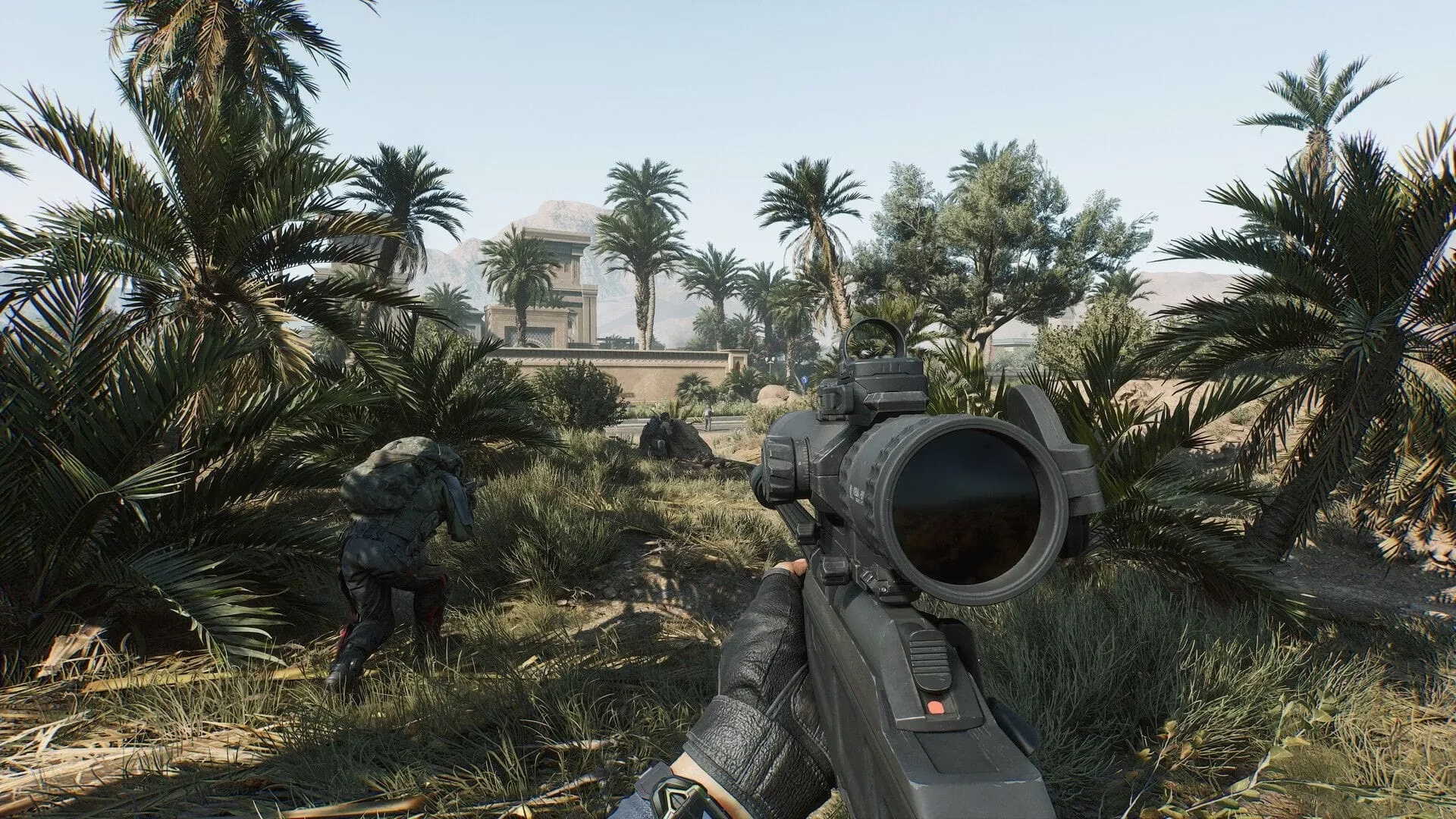
When the Fortifications feature was first announced for Season 2 Starfall, I honestly thought, “Oh great, another gimmick.” But the moment I equipped the Hammer Tool and began pounding glowing outlines into existence, my jaw dropped. This isn’t Minecraft with bullets—it’s a masterclass in real-time defensive engineering that separates the tactical legends from the cannon fodder. The Hammer Tool is accessible to every single class, meaning your medic, your recon sniper, even that assault player who only knows how to hold forward—all of them can become field architects. Why wouldn’t you want the ability to craft cover from thin air? I’ve watched entire squads transform a barren hilltop into a fortress bristling with mounted weapons and chokepoints in less than a minute. It’s pure, unadulterated chaos, and I love every second.
The most beautiful part? Collaboration. Before Fortifications, teamwork meant “try not to friendly-fire.” Now, the construction progress is synchronized across multiple operators. Have you ever experienced four engineers hammering the same mega-barrier while enemy rounds ping off their helmets? I have. It’s a symphony of survival, and the best part is that progress is never lost—even if a partially built structure gets hammered by grenades, we can come back later and finish what we started. No wasted effort. The game remembers our sweat and tears. This isn’t just strategy; it’s a heartfelt commitment to the team’s collective will to defy death itself.
Equipping the Hammer Tool reveals a battlefield overlay that would make an architect weep. Buildable fortifications within range shimmer with construction markers and highlighted outlines, turning the chaos into a blueprint of potential. I can literally see where a barricade will spring up, how it will funnel enemies, and which sightlines it will break. It’s like having a tactical crystal ball. Need a murder hole facing the choke point? Bam, build it. Want a sneaky flank protected by a concrete slab? Consider it done. The visual cues simplify planning so effectively that even my most clueless teammates suddenly turn into prodigies of battlefield engineering. How did we ever survive without this?
And the scoring! Oh, the scoring makes my inner point-hoarder weep with joy. Fortifications contribute to the team score in five gloriously satisfying ways:
-
🔨 Completing fortifications: Nothing beats the ding of a finished bunker.
-
💣 Demolishing enemy fortifications: Blowing up the other team’s hard work? Priceless.
-
🛡️ Fortifications absorbing damage: Even when our walls crumble, they die for us.
-
🎯 Kills from cover created by fortifications: Popping heads from behind my own custom-built murder barricade is an art form.
-
🤝 Allied kills using weapons mounted on the fortifications I built: Watching a teammate mow down a squad with a machine gun I personally bolted onto a wall is a spiritual experience.
Every bullet that pings off my sandbag fortress, every kill my team secures from behind my lovingly crafted walls, every enemy demolition charge that fails to take down my barricade—it all translates into points. The game has become a beautiful, violent co-op construction project. Did anyone expect that from a military shooter? I sure didn’t.
Fast forward to 2026, and Fortifications have utterly rewritten the DNA of Delta Force. Maps like Trainwreck and Knife Edge became legendary proving grounds for builders, and the Engineer Operator Alexei “Sineva” Petrov has become every fortifier’s best friend. I’ve seen entire matches decided not by who had the best aim, but by who erected the most cleverly placed bunker. Remember when capturing a point meant exposing your entire body to ten angles of instant death? Now, my team rolls in, hammers swinging, and within seconds we’ve created a spiderweb of covered positions that leaves the enemy bewildered. They can’t push without getting shredded; they can’t hold without getting flanked through our custom-built kill corridors. It’s tactical superiority on steroids.
The true magic is the dynamic adaptation. One minute I’m throwing up a hasty low wall to block sniper fire, the next I’m rallying three teammates to build a fortress that turns a losing point defense into a heroic last stand. The constant question pinging in my head: “What can we build to survive this specific mess?” Every match becomes a puzzle, and I’m the mad engineer solving it with concrete and steel. If you haven’t experienced the ecstasy of turning a wide-open death trap into a chokepoint nightmare for the enemy, have you even played Delta Force since 2025?
In conclusion, Fortifications didn’t just add a feature; they spawned an entire subculture of builder-warriors. We’re not just soldiers anymore—we’re combat architects, defensive visionaries, and the reason half the enemy team rage-quits. The Hammer Tool is my Excalibur, and every match is a new cathedral of destruction I get to construct. Teamwork has never been this tangible, kills have never been this satisfying, and battles have never been this gloriously over-the-top. If you’re still running around without ever swinging a hammer, I have one question: what in the world are you doing? Embrace the build. Become the bulwark. Fortify or die trying.
Let me just say it: I still remember the dark ages before January 18, 2025, when matches in Delta Force were nothing but running, gunning, and praying nobody was watching your back. I was just another soldier with a rifle, a dream, and absolutely zero protection. Then Season 2 Starfall dropped, and my entire tactical existence shattered—rebuilt with the glorious Fortifications system. Even now, in 2026, I can’t stop talking about it. Can you imagine a battlefield where YOU personally erect a steel barricade, slap down a sandbag wall, and turn an open killing field into an impenetrable stronghold? Because I’ve been living that dream for over a year, and it’s absolutely bonkers.
When the Fortifications feature was first announced for Season 2 Starfall, I honestly thought, “Oh great, another gimmick.” But the moment I equipped the Hammer Tool and began pounding glowing outlines into existence, my jaw dropped. This isn’t Minecraft with bullets—it’s a masterclass in real-time defensive engineering that separates the tactical legends from the cannon fodder. The Hammer Tool is accessible to every single class, meaning your medic, your recon sniper, even that assault player who only knows how to hold forward—all of them can become field architects. Why wouldn’t you want the ability to craft cover from thin air? I’ve watched entire squads transform a barren hilltop into a fortress bristling with mounted weapons and chokepoints in less than a minute. It’s pure, unadulterated chaos, and I love every second.
The most beautiful part? Collaboration. Before Fortifications, teamwork meant “try not to friendly-fire.” Now, the construction progress is synchronized across multiple operators. Have you ever experienced four engineers hammering the same mega-barrier while enemy rounds ping off their helmets? I have. It’s a symphony of survival, and the best part is that progress is never lost—even if a partially built structure gets hammered by grenades, we can come back later and finish what we started. No wasted effort. The game remembers our sweat and tears. This isn’t just strategy; it’s a heartfelt commitment to the team’s collective will to defy death itself.
Equipping the Hammer Tool reveals a battlefield overlay that would make an architect weep. Buildable fortifications within range shimmer with construction markers and highlighted outlines, turning the chaos into a blueprint of potential. I can literally see where a barricade will spring up, how it will funnel enemies, and which sightlines it will break. It’s like having a tactical crystal ball. Need a murder hole facing the choke point? Bam, build it. Want a sneaky flank protected by a concrete slab? Consider it done. The visual cues simplify planning so effectively that even my most clueless teammates suddenly turn into prodigies of battlefield engineering. How did we ever survive without this?
And the scoring! Oh, the scoring makes my inner point-hoarder weep with joy. Fortifications contribute to the team score in five gloriously satisfying ways:
-
🔨 Completing fortifications: Nothing beats the ding of a finished bunker.
-
💣 Demolishing enemy fortifications: Blowing up the other team’s hard work? Priceless.
-
🛡️ Fortifications absorbing damage: Even when our walls crumble, they die for us.
-
🎯 Kills from cover created by fortifications: Popping heads from behind my own custom-built murder barricade is an art form.
-
🤝 Allied kills using weapons mounted on the fortifications I built: Watching a teammate mow down a squad with a machine gun I personally bolted onto a wall is a spiritual experience.
Every bullet that pings off my sandbag fortress, every kill my team secures from behind my lovingly crafted walls, every enemy demolition charge that fails to take down my barricade—it all translates into points. The game has become a beautiful, violent co-op construction project. Did anyone expect that from a military shooter? I sure didn’t.
Fast forward to 2026, and Fortifications have utterly rewritten the DNA of Delta Force. Maps like Trainwreck and Knife Edge became legendary proving grounds for builders, and the Engineer Operator Alexei “Sineva” Petrov has become every fortifier’s best friend. I’ve seen entire matches decided not by who had the best aim, but by who erected the most cleverly placed bunker. Remember when capturing a point meant exposing your entire body to ten angles of instant death? Now, my team rolls in, hammers swinging, and within seconds we’ve created a spiderweb of covered positions that leaves the enemy bewildered. They can’t push without getting shredded; they can’t hold without getting flanked through our custom-built kill corridors. It’s tactical superiority on steroids.
The true magic is the dynamic adaptation. One minute I’m throwing up a hasty low wall to block sniper fire, the next I’m rallying three teammates to build a fortress that turns a losing point defense into a heroic last stand. The constant question pinging in my head: “What can we build to survive this specific mess?” Every match becomes a puzzle, and I’m the mad engineer solving it with concrete and steel. If you haven’t experienced the ecstasy of turning a wide-open death trap into a chokepoint nightmare for the enemy, have you even played Delta Force since 2025?
In conclusion, Fortifications didn’t just add a feature; they spawned an entire subculture of builder-warriors. We’re not just soldiers anymore—we’re combat architects, defensive visionaries, and the reason half the enemy team rage-quits. The Hammer Tool is my Excalibur, and every match is a new cathedral of destruction I get to construct. Teamwork has never been this tangible, kills have never been this satisfying, and battles have never been this gloriously over-the-top. If you’re still running around without ever swinging a hammer, I have one question: what in the world are you doing? Embrace the build. Become the bulwark. Fortify or die trying.